My great-grandfather Carl Luetcke was born in Germany in 1874 and moved to the United States in 1902. He retained social ties and sympathies with his birth country through the outbreak of the Great War.
Here he is in 1917 being interviewed by the local newspaper in Austin, Texas about his experiences.
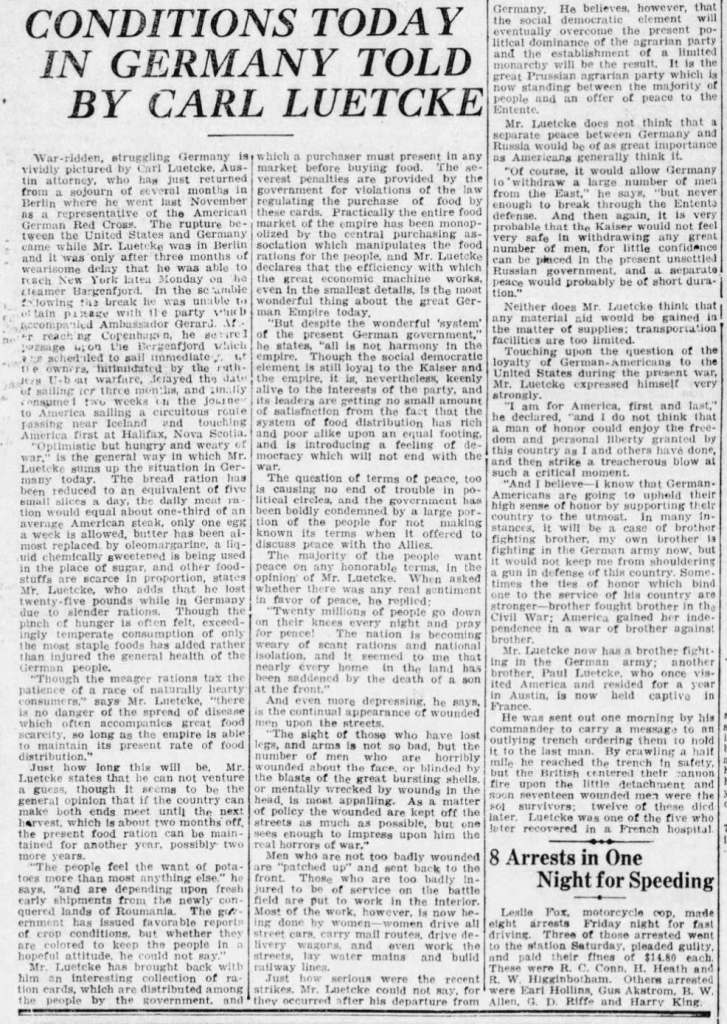
I posted about this on social media in December 2022 and transcribed the article at that time. The transcript follows.
Conditions Today in Germany Told by Carl Luetcke
06 May 1917, Sun · Page 7
War-ridden, struggling Germany is vividly pictured by Carl Luetcke, Austin attorney, who has just returned from a sojourn of several months in Berlin where he went last November as a representative of the American German Red Cross. The rupture between the United States and Germany came while Mr. Luetcke was in Berlin and it was only after three months of wearisome delay that he was able to reach New York late Monday on the steamer Bergenfjord. In the scramble following the break he was unable to obtain passage with the party which accompanied Ambassador Gerard. After reaching Copenhagen, he secured passage upon the Bergenfjord which was scheduled to sail immediately, but the owners, intimidated by the ruthless U-boat warfare, delayed the date of sailing for three months, and finally consumed two weeks on the journey to America sailing a circuitous route passing near Iceland and touching America first at Halifax, Nova Scotia.
“Optimistic but hungry and weary of war,” is the general way in which Mr. Luetcke sums up the situation in Germany today. The bread ration has been reduced to an equivalent of five small slices a day, the daily meat ration would equal about one-third of an average American steak, only one egg a week is allowed, butter has been almost replaced by oleomargarine, a liquid chemically sweetened is being used in the place of sugar, and other foodstuffs are scarce in proportion, states Mr. Luetcke, who adds that he lost twenty-five pounds while in Germany due to slender rations. Though the pinch of hunger is often felt, exceedingly temperate consumption of only the most staple foods has aided rather than injured the general health of the German people.
“Though the meager rations tax the patience of a race of naturally hearty consumers,” says Mr. Luetcke, “there is no danger of the spread of disease which often accompanies great food scarcity, so long as the empire is able to maintain its present rate of food distribution.”
Just how long this will be, Mr. Luetcke states that he can not venture to guess, though it seems to be the general opinion that if the country can make both ends meet until the next harvest, which is about two months off, the present food ration can be maintained for another year, possibly two more years.
“The people feel the want of potatoes more than anything else,” he says, “and are depending upon fresh early shipments from the newly conquered lands of Roumania. The government has issued favorable reports of crop conditions, but whether they are colored to keep the people in a hopeful attitude, he could not say.”
Mr. Luetcke has brought back with him an interesting collection of ration cards, which are distributed among the people by the government, and which a purchaser must present in any market before buying food. The severest penalties are provided by the government for violations of the law regulating the purchase of food by these cards. Practically the entire food market of the empire has been monopolized by the central purchasing association which manipulates the food rations for the people, and Mr. Luetcke declares that the efficiency with which the great economic machine works, even in the smallest details, is the most wonderful thing about the great German Empire today.
“But despite the wonderful ‘system’ of the present German government,” he states, “all is not harmony in the empire. Though the social democratic element is still loyal to the Kaiser and the empire, it is, nevertheless, keenly alive to the interests of the party, and its leaders are getting no small amount of satisfaction from the fact that the system of food distribution has rich and poor alike upon an equal footing, and is introducing a feeling of democracy which will not end with the war.
The question of terms of peace, too is causing no end of trouble in political circles, and the government has been boldly condemned by a large portion of the people for not making known its terms when it offered to discuss peace with the Allies.
The majority of the people want peace on any honorable terms, in the opinion of Mr. Luetcke. When asked whether there was any real sentiment in favor of peace, he replied:
“Twenty millions of people go down on their knees every night and pray for peace! The nation is becoming weary of scant rations and national isolation, and it seemed to me that nearly every home in the land has been saddened by the death of a son at the front.”
And even more depressing, he says, is the continual appearance of wounded men upon the streets.
“The sight of those who have lost legs, and arms is not so bad, but the number of men who are horribly wounded about the face, or blinded by the blasts of the great bursting shells, or mentally wrecked by wounds in the head, is most appalling. As a matter of policy the wounded are kept off the streets as much as possible, but one sees enough to impress upon him the real horrors of war.”
Men who are not too badly wounded are “patched up” and sent back to the front. Those who are too badly injured to be of service on the battle field are put to work in the interior. Most of the work, however, is now being done by women—women drive all street cars, carry mail routes, drive delivery wagons, and even work the streets, lay water mains and build railway lines.
Just how serious the recent strikes, Mr. Luetcke could not say, for they occurred after his departure from Germany. He believes, however, that the social democratic element will eventually overcome the present political dominance of the agrarian party and the establishment of a limited monarchy will be the result. It is the great Prussian agrarian party which is now standing between the majority of people and offer of peace to the Entente.
Mr. Luetcke does not think that a separate peace between Germany and Russia would be of as great importance as Americans generally think it.
“Of course, it would allow Germany to withdraw a large number of men from the East,” he says, “but never enough to break through the Entente defense. And then again, it is very probable that the Kaiser would not feel very safe in withdrawing any great number of men, for little confidence can be placed in the present unsettled Russian government, and a separate peace would probably be of short duration.”
Neither does Mr. Luetcke think that any material aid would be gained in the matter of supplies; transportation supplies are too limited.
Touching upon the question of the loyalty of German-Americans to the United States during the present war, Mr. Luetcke expressed himself very strongly.
“I am for America, first and last,” he declared, “and I do not think that a man of honor could enjoy the freedom and personal liberty granted by this country as I and others have done, and then strike a treacherous blow at such a critical moment.
“And I believe—I know that German-Americans are going to uphold their high sense of honor by supporting their country to the utmost. In many instances, it will be a case of brother fighting brother, my own brother is fighting in the German army now, but it would not keep me from shouldering a gun in defense of this country. Sometimes the ties of honor which bind one to the service of his country and stronger—brother fought brother in the Civil War; America gained her independence in a war of brother against brother.
Mr. Luetcke now has a brother fighting in the German army; another brother, Paul Luetcke, who once visited America and resided for a year in Austin, is now held captive in France.
He was sent out one morning by his commander to carry a message to an outlying trench ordering them to hold to the last man. By crawling a half mile he reached the trench in safety, but the British centered their cannon fire upon the little detachment and soon seventeen wounded men were the sole survivors; twelve of these died later. Luetcke was one of the five who later recovered in a French hospital.
 A Place to Call My Own
2 responses to “1917 News article featuring my great-grandfather”
This news article is a great find. You have some great facts and insights into your great grandfather that many do not have about their own father.
LikeLiked by 1 person
I agree! It’s a way of knowing a man who died three years before I was born but had a huge influence on people in my life. There are actually a lot of articles about him on newspapers.com because he was a fairly public figure in Austin at the time. I can reconstruct his activities down to the day in some cases.
LikeLiked by 1 person