(Ancestors of Charles Mirza Weller)
Origins in Germany
The Weller family originated in the 17th century (if not earlier) in Zeppenfeld, now a part of the city of Neunkirchen in Siegen-Wittgenstein, in North Rhine-Westphalia, Germany.
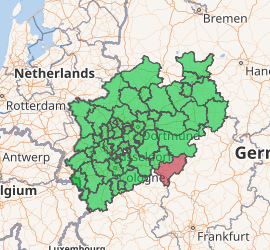
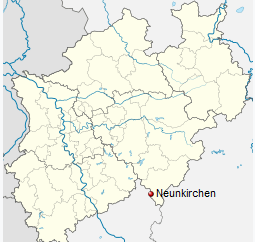
Engelbert Weller and his wife Anna were the parents of Rupert Weller, who was baptized 14 August 1653. Rupert Weller married Margaretha Helman in 1681. Their son Johann Hieronimus Weller was born in 1684, and married Anna Kuntz on 2 January 1707 in Oberfischbach.
The political history of Zeppenfeld is complicated, and it was particularly ravaged by the religious conflict during conflicts like the Thirty Years’ War. It also was destabilized by the War of the Spanish Succession.
Palatine immigration
In the wake of these conflicts of the 17th century, many people sought their fortunes elsewhere, sometimes manipulated by exaggerated promises of riches if they emigrated. Thousands of those people (at least 13,000 in all) ended up heading toward England via the Netherlands, most with the intention of moving on to America. Rupert and Margaretha’s Weller’s son Johann Hieronimus Weller and his wife Anna joined these thousands.
The “Palatine Germans” (so named after the location of many of the immigrants in Palatine territories associated with the Holy Roman Empire) began arriving in London in June 1709 and throughout the following summer. Their arrival sparked a huge uproar in London. Politicians began exploiting the situation, blaming French persecution for the arrival of the refugees, characterizing them as oppressed Protestant refugees fleeing Catholic tyranny (despite diverse religious affiliations among the immigrants). Queen Anne thought England could benefit by retaining the new force of laborers rather than sending them on to the colonies. The Whig government proceeded in an attempt to settle the immigrants in England.
The immigrants took advantage of this environment and appealed to aid based on these stereotypes, and there was an initial outpouring of financial aid from sympathetic Londoners. But public opinion began turning against the immigrants near the end of the summer of 1709, with them being maligned as disease-ridden “gypsies” because of the disease that was spreading in their refugee camps. They also were increasingly seen less as sympathetic Protestants and more foreign, influenced by French and Catholic culture, and so suspect. There were rumors than local laborers were planning attacks on the refugee camps.
The Whig government abruptly changed direction and started looking for a way to get rid of the immigrants. It demanded that Catholics among them convert or leave. Most left. Of the remaining Protestant-only population, 3000 were sent to (northern) Ireland to increase the Protestant population there. 600 were sent to Carolina (which had been promoted as a land of riches and was the desired destination of most of the Palatines). Half of those died during transport and 60 more died in 1711 during the Tuscarora War after arriving.
Most of the Palatines, including Hieronimus, were sent to New York, falling under the control of newly appointed Governor Robert Hunt, who traveled with the immigrants to New York. His plan was to settle them in pine forests in the Hudson Valley and indenture them making tar and pitch for the British Navy. They would work off their debt while serving as a buffer between the British and French populations, and would be granted 40 acres per family after their term of service. The German-speaking immigrants were not happy about this scheme, but it was a way to get to America, so they agreed. They left England in April 1710 and arrived in New York in mid-June.
One consequence of the year in London is that it drew together people who had come from different principalities and regions, followed different creeds of Protestant Christianity, and had many historical and cultural differences. One quarter of the immigrants sent to New York died before arrival. Widows and widowers quickly remarried, and orphans were adopted by other families, which increased the sense of social cohesion. By the time they arrived in New York, they had a nascent group identity via their shared experiences.
Palatines in New York
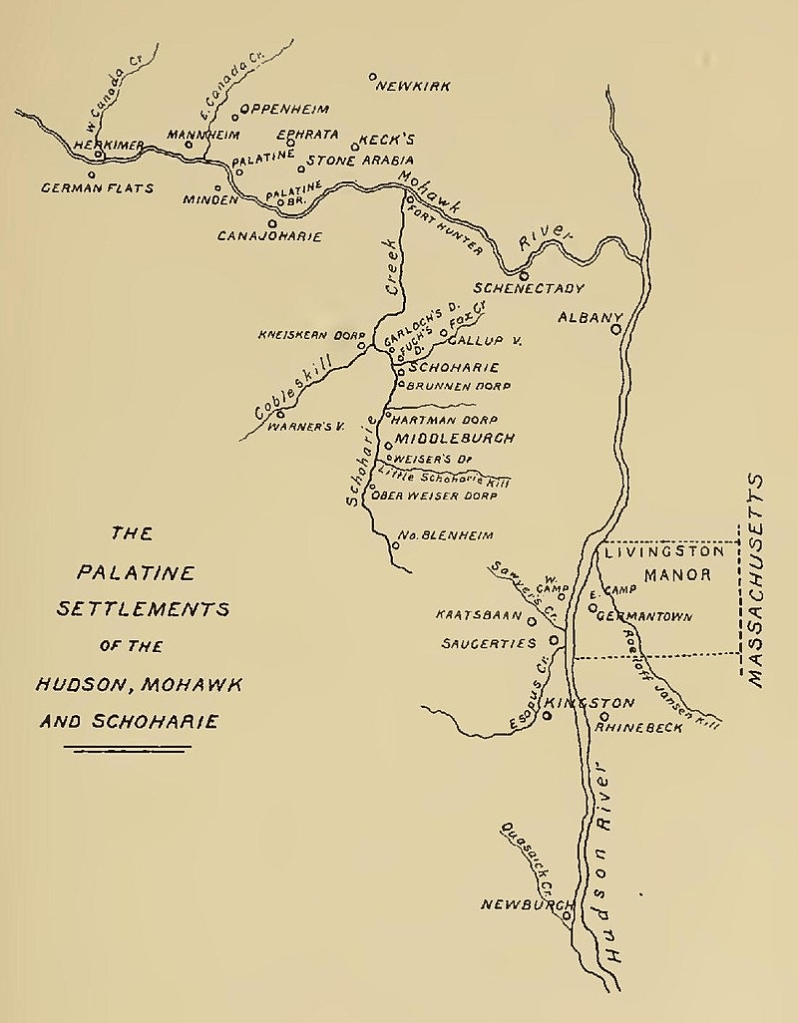
After arrival in New York City, the Palatine immigrants were sent to encampments 90 miles up the Hudson River. Hieronimus was among those who was settled in crude villages (really more like work camps) on property owned by Lord Robert Livingston the Elder. Hieronimus was assigned to West Camp.
Upon arriving in makeshift work camps, the immigrants began arguing that they had been swindled out of promises of land and were being turned back into feudal serfs, and began to organize to resist their situation. At one point they threatened to attack the governor, and refused to work. Governor Hunter had to call in troops to disarm them, but the resistance continued.
Amid this resistance, the overall scheme was not sustainable. Almost no pine tar was produced, and necessary supplies were dwindling. The governor abandoned the scheme and left the immigrants to their own devices. Some went back to New York City. Others integrated into existing settlements around the Hudson Valley. Others worked to secure independent land claims in places like the Schoharie Valley, often negotiating with the local indigenous population (the Mohawks) who wanted a buffer against expansion by the colonial powers. Those colonial powers in turn saw the German-speaking settlers as a buffer against the Mohawks, and each other.
Wellers of Orange County, New York
Hieronimus Weller’s stayed in West Camp (in Ulster County) for several years. His children born through 1716 were baptized there. He had seven children. His first two children (Anna Catharina (1707-1709) and Johann Jacob (1708-1708)) were born in Oberfischbach, Germany. Neither made it out of Oberfischbach, much less to America. Jacob died in infancy in 1708 and Anna Catharina died 3 March 1709 in Oberfischbach just before the family’s migration through the Netherlands.
His children Johann Friedrich (1712), Hieronimus Adam (1713), Johann Wilhelm (1715), Johann Henrich (1716) were baptized in West Camp, New York. Son Johannes (1721) was baptized in Kingston Reformed Church in Kingston, New York (this does not seem to be the more famous church in New York City with a similar name). There is also a record of Hieronymous receiving land in Kingston on March 6 1715/16, so the family was preparing to move to Kingston (about 40 miles south of West Camp, still in Ulster County) even before the birth of Johann Henrich.
By the time the immigrant Hieronimus Weller died in 1747 (recorded in the New York City Reformed Church books), most of his family seems to have been living in Orange County, New York, in a town just west of Newburgh now called Montgomery but then called Hanover. Hanover was founded in 1710 by Palatine immigrants. (For convenience, it’s called Montgomery below despite not being renamed until 1778.)
The descendants of Hieronimus lived in Orange County for over a century (and some might still live there).
Henrick Weller (1716-1756)
Johann Henrich (1716-1756), who went by Henrick, was born in West Camp. He married Anna Catryna Maul (born in Wallkill and herself the daughter of Palatine immigrants Christoffel Maul and Anna Juliana Sergius) in Kington in 1739. He joined the Montgomery Reformed Church in 1744. Their children, all born in Montgomery, were Anna Juliana (1740, d. young), Anna Juliana (1742), Wilhelmus (1745-1777), Philip (1747), Magdalena (1751), and Catharina (1753).
Wilhelmus Weller (1745-1777)
Wilhelmus Weller was baptized 20 May 1745 in Montgomery (a William Weller and his wife Marytje Stokkerad are listed as his godparents). Several people were baptized on that same date, and his birth was surely earlier. Based on his listed age on his tombstone, he was probably born in January 1744/45.
He married Eleanor Bull in 1764. She was the daughter of William Bull and Sarah Wells (who claimed to have lived 102 years and was the first white woman in Goshen, Orange County in 1712). This marks the first in a series of Weller marriages to women with at least some English ancestry. William Bull was English, but Sarah Wells was likely an orphan and her ancestry is unknown. Their children were Henry (1766), Ester (1769) Catharina (1773), Philip (1775), and Hyram (1776).
In 1776, Wilhelmus joined the 5th New York Regiment during the Revolutionary War, serving under Col. Lewis DuBois (who had been promoted by the Continental Congress in June and formed the regiment in November). However, he died in March 1777 before any of the unit’s famous engagements (including the Battles of Fort Montgomery and Fort Clinton and the Burning of Kingston in October 1777). He wrote a will 10 days before his death which does not mention the war at all, and notes his profession as a blacksmith. His service is noted on his gravestone.
Henry Weller (1766-1839)
Wilhelmus’ first son Henry was born in Montgomery, Orange County, New York in 1766. He married Ann Kidd (1773-1829), the daughter of Alexander Kidd (1746-1822) and Mehitable Haines (1749-1815). Their children were Sidney (1791), Maria (1792), Emily (1796), Leander (1798), Cecelia (1799), Harvey (1803), Alfred (1805), and Henry Howard (1808).
Sometime after 1800 he moved from Montgomery to Crawford, also in Orange County, New York.
Henry Howard Weller (1808-1862)
Henry Howard Weller was born 14 June 1808 in Crawford, New York. In 1829 he married Mehitable Haines (1809-1872), who was his half second-cousin. (Benjamin Haines (1710-1796) was their great-grandfather via different wives; Henry Howard’s maternal grandmother Mehitable Haines (1749-1815) was Benjamin’s daughter.)
Henry and Mehitable had ten children. Seven or eight were born in Crawford, New York: Henry Nathan (1830), Theodore (1833), Sidney (1835), Jane (1837), Mirza (1840), Edgar (1842), Virgil (1844), and possibly Harvey (1847).
Henry bought land in Michigan on Silver Lake near Cannon Township, Michigan, and about 1846 (the accounts are unclear about whether this was before Harvey’s birth in 1847) he returned via the Erie Canal with his family to settle there. Along the way, according to a family story, Henry apparently saved a young Black girl named Rachel from drowning and adopted her into the family. (There are reasons to be skeptical of this account, but that’s a separate story.)
Shortly after arriving in Michigan, Henry built the first Congregational Church near Bostwick Lake, about a mile from Silver Lake, and was the deacon at the church for the rest of his life. It’s interesting to note that his ancestors had been going to German/Dutch Reformed churches, but his English-American ancestors (going back to the 1630s as Puritans) were likely to have been in Congregational churches. The Reform and Congregational denominations would eventually merge (the current UCC is a descendant church of that merger), and it appears that he was an active part of that historical process within the church.
In 1850, Henry and Mehitable had another son, Howard Morton. The 1850 census lists the whole family (including Rachel) living in Cannon.
In 1852, Henry and Mehitable’s last child Maria was born.
In 1857, their daughter Jane died.
His adopted daughter Rachel is only listed in the 1850 census (age 13), and certainly had moved away by 1860. Based on family stories she might have married a Tom Brown and moved to Grand Rapids when she was 17 (c. 1854). However, she does not appear in the 1860 census there and the rest of her life is a mystery.
Henry died in 1862, while at least three of his sons were off fighting in the Civil War (all of his 4 elder sons would eventually serve in the Union Army, while the four younger sons stayed at home with their mother and sister Maria).
Mirza Weller (1840-1919)
Mirza Weller was born in Crawford, New York and moved with his family about 1846 to Cannon, Michigan.
In 1861, he enlisted with his older brothers Henry (Nathan), Theodore, and Sidney in Company B of the 1st Michigan Engineers, fighting for the Union Army. He mustered out just before Sherman’s march to the sea.
On 1 January 1867 he married his wife Alma Cordelia Nutter (1849-1929). He was baptized as an adult, along with Alma, in the Congregational church at Bostwick Lake (in Rockford, Michigan). His children were Alta Maria (1867), Charles Mirza (1869), Effie Mathilda (1871), and Miles Clifton (1877).
Mirza lived in Cannon township, Michigan near the church on Bostwick Lake until near the end of his life. By 1910 he was living a short distance away in Algoma township on the other side of Rockford (which is outside either township), and he is buried in Rockford Cemetery in Rockford.
Charles Mirza Weller (1869-1948)
Charles Mirza Weller was born 30 November 1869 in Cannon township, Michigan. Before 1900, he moved to North Dakota. In the 1900 census, he was single, working as a servant farm laborer, and living with several other laborers under an M. Keek in Rutland, North Dakota.
In 1902, Charles married Martha Green, a daughter of Norwegian immigrants from Sigdal, Buskerud, Norway. Their children were Ruth (1903-1913), Carroll (1905), Mabel (1907), Ethel (1909), Frances (1913), Clifton (1915), Lloyd (1918), George (1918), Alice (1920), Alvin (1924), and Earl (1926).
Descent
Engelbert Weller (1633-1681)
m. Anna Catharina Helms (1625-1656)
|
Rupert Weller (1653-1709)
m. 1681 Margaretha Helman (1655-1701)
|
Johann Hieronimus Weller (1684-1747)
m. 2 Jan 1707 Anna Juliana Kuntz (1679-1747)
|
Johann Henrich (Henrick) Weller (1716-1756)
m. 26 Aug 1739 Anna Catryna Maul (1717-1764)
|
Wilhelmus Weller (1745-1777)
m. 1764 Eleanor (Petronella) Bull (1745-1818)
|
Henry Weller (1766-1839)
m. Ann Kidd (1773-1829)
|
Henry Howard Weller (1808-1862)
m. 27 Dec 1829 Mehitable Haines (1809-1872)
|
Mirza Weller (1840-1919)
m. Alma Cordelia Nutter (1849-1929)
|
Charles Mirza Weller (1869-1948)
m. Martha Green (1883-1963)
|
Lloyd Alton Weller (1918-1967)
|
At least 14 descendants, 12 still alive
Notes
Most of the early general history of the Palatine German immigration here is a summary of “The 1709 Palatine Migration and the Formation of German Immigrant Identity in London and New York,” by Philip Otterness, Warren Wilson College.
Information about the early Weller family in particular is from:
The Palatine Families of New York Volume II – Palatine German Immigration to Ireland and U.S., Hank Z Jones collection, 1654-1878
[database on-line]. Lehi, UT, USA: Ancestry.com Operations, Inc., 2023.
Original data:Palatine German Immigration. Hank Z Jones. Description: This collection contains the family trees of immigrants from the Palatinate region (part of present-day Germany) of the Holy Roman Empire between 1654 and 1878.
https://www.5thny.org/about-history 5th New York Regiment “History of the 5th NY” retrieved 11 Sep 2023.
 A Place to Call My Own