(Ancestors of Lydia Nurro)
Origins
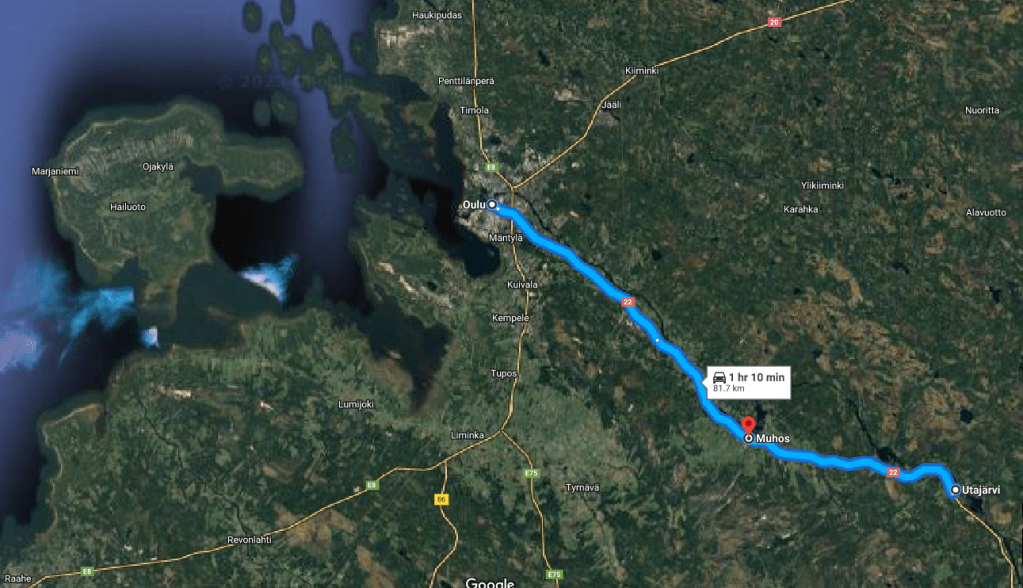
The Nurro family originates in Utajärvi, Muhos, Finland.
(Much of the early account here is gleaned from a discussion at https://suku.genealogia.fi/archive/index.php/t-13706.html. I have not found the supporting sources for the information, most of which appear to not be digitally available.)
According to the book “Utajärven asutushistoria” (“Utajärvi’s settlement history”) written by professor Pentti Virrankoski, a man known as Olli Matinpoika (Swedish Olof Matsson) founded a new settlement in 1608 when he was in his fifties.

According to lists of fields and livestock, this settlement passed into the ownership of his son Matti Ollinpoika (Mats Olsson) in 1624, and then to his son Olli Matinpoika (Olof Mattson) by 1626. By 1645 the settlement was known as Nurro. This younger Olli had a younger brother Mats Nurro (also Mats Postila b. c. 1605), who was listed in 1675 as a widower and the householder of Utajärvenkylä who had a son Elias and daughter Valpuri.
The Nurro settlement grew and split into subsidiary settlements, including one called Postila (literally “post office”) around 1690, which might actually have been the original settlement renamed. (Other related Nurro settlements in Utajärvi were Putaala and Roininen.)
In 1696, the Great Famine of Finland (1696-1699) hit the country. About one third of the entire country (then a region of Sweden) died during this famine. By 1698 the Nurro settlement was abandoned as a consequence of this famine.
The 1699 householder of the place where Elias was householder in 1675 was Olli, who could have been brother or son of Elias.
Juho Eliaanpoika Nurro (c. 1650-1699), son of the same Elias, was listed as owner of Postila when he died.
Juho Juhonpoika Nurro (Johan Johansson Nurro) (1689-1756)
Juho Juhonpoika Nurro, son of Juho Elianpoika, was born about 1689 in Utajärvi.
The early part of his life was surely affected by the Great Famine and the subsequent Great Northern War (1700-1721) The war included a Russian occupation of Finland called “The Great Wrath” 1714-1721. These events killed nearly half the population of Finland, which was a main battleground between Sweden and Russia.
In the 1699-1722 communion records for Påsti (Postila)/Ollila in Utajärwi, Juho is living on his father-in-law Anders Ollila’s property with his wife Carin Ollila (aka “Kaisa”), and he lived there through 1732. By 1733 he was the owner of Utajärvi 2.
His children included Jöran/Johan (1726), Carin (1727), Jacob (1728), Erik (1728-twin or same as Jacob?), Isaac (1730), Maria (1731), and Lisa (1736).
An ill-advised war by Sweden resulted in another defeat and occupation of Finland by Russia (the Lesser Wrath) in 1741-1742. This event seems to have hit Juho hard.
Per the profile at geni.com, Juho in 1745 was living in Utajärvi and had gone blind. Quoting from a longer account on that page (via Google translate):
“[At the] [w]inter meetings of the keepers of Oulu and Hailuoto 26., 28.-31.1745 (MF2071): 258-260 it is said that Juho Nurro from Utajärvi owns a kestikievari [rural inn for horse travelers, mail delivery, transport of dignitaries] and also handles mail delivery. Due to years of blackouts and other great misfortunes, he has become very impoverished and sunk into considerable bourgeois debt and fallen into extreme distress. And he therefore no longer remains properly to maintain and cultivate the house in which he dwells, and to perform outward burdens to his royal majesty and crown. Because of this, Juho Nurro is requesting that the holding of the rifle be transferred to someone else, because he is unable to keep and carry the mail alone, as most of his horses were driven to death or otherwise ruined during the last Russian occupation. This story was confirmed by the ferry crew and all the local people present. This has been entered into the protocol and a certificate is given to Juho Nurro at his own request, which he can present to the high-born count and the lord.”
At some point (it’s unclear if this was before or after his death), “the authorities expropriated Juho Nurro’s house for the Utajärvi chaplain’s rectory.”
Juho died on 11 April 1756.
Erich Johansson (Erik) Nurro (c. 1728-1803)
Erik Johansson Nurro was born about 1728 on Nurro #2 farm (then in Muhos country parish), the son of Johan Nurro and Carin Andersson Ollila. His birth record has not been found, but 1728 is listed on communion records and matches his age at death (75) in 1803.
His family appears in communion records in 1733-1740 but it’s unclear if he is recorded (it’s hard to read). He is listed in those records starting 1741-1749 and through 1791.
He lived through the Lesser Wrath, a Russian occupation in 1741-1742.
Erik married Lisa Pehrsdr Poutiainen in 1751. Their children included Catharina (1751), Elisabeta (1754), Johannes (1757) and Petrus (1759). His wife Lisa died in 1764.
The 1792-1803 communion records are missing but his 1803 death has been noted in the latest communion record that still exists. He died 9 January 1803 and was buried on 2 February.
Pehr Eriksson Nurro Postila (1759-1811)
Pehr Eriksson Nurro, aka Postila, was born 1 December 1759 in Utajärvi.
The first clear reference to him in communion books was in 1775[2]. He lived on the Nurro farm in Utajärvi with his parents and siblings.
Some time after 1785 (the record has not been found) he married Lisa Holm and she moved with him to the Nurro farm. They had six children who died shortly after birth or in infancy until son Isak was born in 1795[3]. They later also had Pehr (1797), Brita Margeta (1803), and Mats (1805).
After 1804, their farm was known as “Nurro 2[4].” His wife Lisa died in 1809[5], and Pehr passed away in 1811[6]. He was using Postila as a surname at that time.
Their surviving children, then 16 or younger, continued to live on Nurro farm with extended family[7].
Isac Pehrss Nurro (1795 – 1862)
Isac Nurro was born on 26 July 1795 in Utajärvi.
Before he reached adulthood, the Finnish War broke out between Russia and Sweden in 1808 over demands by Napoleon for Sweden to join in the Continental System (a blockade of Britain by France that was supported by Russia and Denmark). The war took place mostly in Finland, with some battles not far from Utajärvi, and by its conclusion the next year, Sweden lost its Finnish territory (one third of its pre-war kingdom) to Russia, which founded the Grand Duchy of Finland as an autonomous territory within the Russian Empire. This separation from Sweden accelerated the growth of Finnish national identity that would eventually lead to independence a bit more than a century later.
Isac married Walborg Pellicka 13 April 1815 in Utajärvi. Their children included Pehr (1815), Isak (1817), Lisa (1819), Erik (1820), Matts (1823), Carl Benjamin (1826), Johan (1828), Saara Maria (1830), and Abram (1833).
Isac’s wife Walborg died in 1833, and he remarried in 1844 to Caisa Johansdr Vimbari. He died 12 September 1862 in Utajärvi.
Erik Isackson Nurro (1820 – 1866)
Erik Isackson Nurro was born 7 December 1820 in Utajärvi.
He was apparently the father of an illegitimate son Erik born in 1846. He married Erik’s mother Brita Puhacka on 21 Nov 1848 in Utajärvi. Their other children were Kaisa (1849-1851), Isaac (1851), Maria (1852), Anders (1855), and Brita Kaisa (1858).
In 1854, during naval battles associated with the Crimean War (called the Åland War), the British Royal Navy landed troops near Oulu (not far from Utajärvi) demanding firewood and threatening to burn down the city.
He passed away in Kylmälä in Utajärvi in 1866.
Erik Eriksson Nurro (1846-1929)
Erik Eriksson Nurro (Finnish: Erkki Erkkinpoika Nurro) was born 20 August 1846 in Utajärvi. His mother Brita Puhakka is the only parent listed on his baptism record, which notes he was illegitimate.
After living for about a year with his mother’s family, he and his mother moved into the household of Erik Isacks Nurro in 1847. His mother later married Erik Isacks Nurro on 21 November 1848 and had more children.
Although his father is not listed on his birth records, all indications are that he was this Erik’s biological father. His apparent paternal uncle Isack Nurro (and Isack’s wife Maria) are recorded as his godparents. In addition, DNA matches of cousins along this line support the fact that the elder Erik was indeed this Erik’s biological father. (The only alternative would be one of Erik’s brothers, such as Isack.)
In late 1869, he is listed as living in Muhos with his siblings and mother.
In 1875, he married Elsa Stina Iisakintytär Niemelä in Muhos[1]. She died in 1876[2].
He continued to be recorded in communion records for Muhos from 1881-1890. On 28 December 1883 he married Fredrika Juhontytär Petäjäniemi in Muhos. He is listed living with her at the Petäjäniemi farm in Kylmälä, Muhos from 1892-1896. They had at least one daughter, Kaisa Lydia, born 23 April 1892.
He passed away about 1929. (The record is not available due to Finnish privacy laws about family records, which limit public information to records at least 125 years old, and allow some limited access to members of genealogical societies to records 100-125 years old.)
Kaisa Lydia Nurro (1892-1975)
Kaisa Lydia Nurro was born on 23 April 1892 in Kylmälä, Muhos, Finland. She was the daughter of Erkki Nurro and Fredrika Juhontytär Petäjäniemi.
In 1912, she left Finland for the United States. She departed via Liverpool England on 19 July 1912 on the ”Virginian” bound for Quebec, Canada (with her intended destination listed as South Range, Michigan where her friend Reeta Lehta was supposedly living). She had $25 in her pocket. The ship arrived in Quebec on 27 July 1912 and then she took the Canadian Pacific Railway, entering the US at “Soo” (presumably Sault Ste. Marie), Michigan.
Within a handful of years she moved to Butte, Montana. Her exact time of arrival is unknown. She married Victor Heino on 21 November 1916 in Butte and had one son, Ralph Victor Heino, born 2 May 1917.
Some time after 1920, when she was recorded living in Butte for the census, Lydia and her family moved to Aberdeen, Washington. Her husband Victor had developed health problems from working in the copper mines and by 1930 he had opened a barbershop in Aberdeen.
By 1940, her husband Victor was still at the barbershop, her son Ralph was a student at the local community college, and they had two lodgers living with them in their house in Aberdeen.
Victor died in 1943. Lydia finally got her US citizenship in 1944.
On 16 January 1945 she remarried to Thomas Arvid (“Tom”) Brown in Montesano, Washington. By 1948 she was living in the Capitol Hill neighborhood of Seattle, and was still living there in 1950. Her husband Tom Brown was listed as “loading goods on freighters (steamship)” in the commercial shipping industry (he was a member of the longshoreman’s union).
Her son Ralph finished military duty in San Antonio, Texas and after working at the San Antonio Symphony, he moved back to be near his mother about 1949 or so, at which time he joined the Seattle Symphony. Lydia’s husband Tom Brown helped get Ralph a second job as a longshoreman in 1957.
About 1967, Lydia sustained a “cerebral vascular fracture” (a traumatic brain injury) as noted in her death record. She apparently never recovered from this injury, moving into the Burien Terrace Nursing Center where she was under care until her death eight years later. She died on 20 June 1975 of “coronary thrombosis” that occurred 30 minutes before death, with her earlier brain injury listed as a contributing factor.
Descent
Olli Matinpoika (c. 1552-c. 1624)
|
Matti Ollinpoika (c. 1577-c. 1626)
|
Mats Posti (c. 1605-1674)
|
Elias Matinpoika Nurro Posti (c. 1630-c. 1712)
m. Anna (c. 1640-1691)
|
Juho Posti Nurro (c. 1650-1699)
m. Brita
|
Juho Juhonpoika Nurro (1689-1756)
m. Kaisa Antintytär Ollila (1699–1750)
|
Erkki Juhonpoika Nurro (1728-1803)
m. 26 Feb 1751 Liisa Pekantytär Poutiainen (aka Pyykkö) (1728-1764)
|
Pekka Erkinpoika Nurro (1759-1811)
m. Liisa Holm (1760–1809)
|
Isac Pehrss Nurro (1795-1862)
m. 13 Apr 1815 Valpuri Erkintytär Pyykkö (1794-1833)
|
Eric Isacsson Nurro (1820-1866)
m. 21 Nov 1848 Brita Antiityatar Puhakka (1827–1866)
|
Erkki Erkkinpoika Nurro (1846-c. 1929)
m. 28 Dec 1883 Fredrika Juhontytär Petäjäniemi (1859-?)
|
Kaisa Lydia Nurro (1892-1975)
m. Victor Heino (1889-1943)
|
One child (deceased)
One grandchild (still living)
Two great-grandchildren (still living)
Five great-great grandchildren (still living)
 A Place to Call My Own