(Ancestors of Carl Julius Luetcke)
Origins in Germany
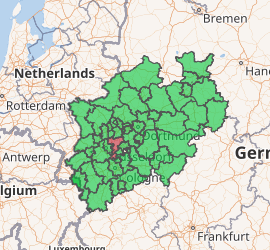
The known origins of the Luetcke family are in Langenberg, which today is a borough of Velbert in the district of Mettmann in North Rhine-Westphalia, Germany.
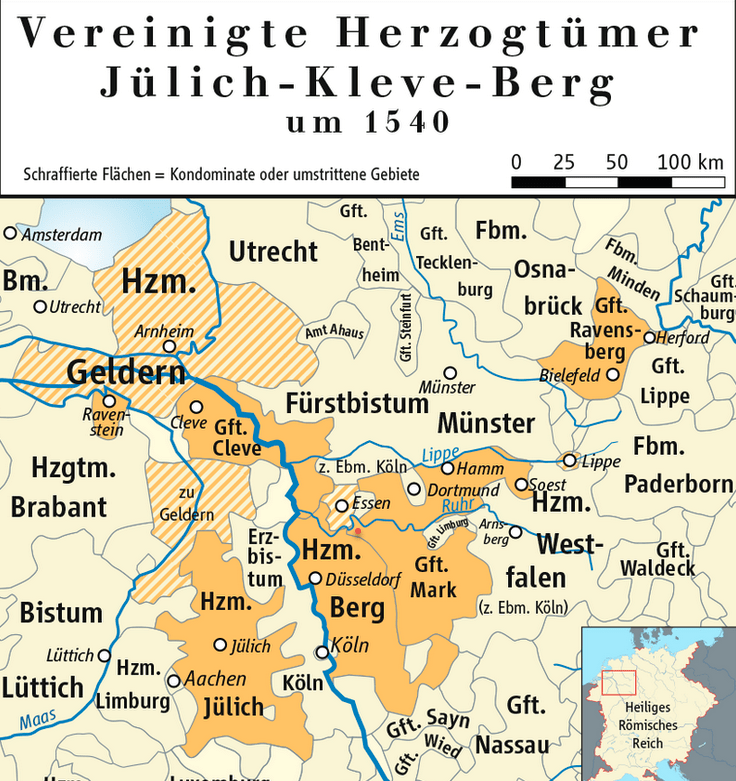
The political geography of the area was historically complicated. Langenberg was historically barely in the County of the Mark, just west of the Duchy of Berg (Velbert proper was in the Duchy of Berg). The regions in the map below were from 1511-1614 the United Duchies of Jülich-Cleves-Berg (which included both Mark and Berg), and after the male line died out in 1609 there was a succession crisis until the late Duke’s daughters married men who split the territories. Berg and Jülich became part of the Palatinate-Neuburg. Cleve and the Mark (and thus Langenberg) became part of the Electorate of Brandenburg in 1614, and then part of Prussia in 1701.
Wilhelm Luetger (b. c. 1695)
The first record of any kind for the family is a marriage on 26 October 1720 between Wilhelm Luetger (as the name was then spelled) (b. c. 1695) and Richmuth Sombeck (b. 1699), the daughter of Petern in der Sombeck and Maria Elisabeth Luhenschlodt. They were married in the Evangelical Lutheran church in Langenberg.
Their children were Adel Heyd Margaretha (1721), Christina Gertraud (1724), Johannes (1726, prob. d. young), Johannes (1729), Anna Maria (1732), Johan Henrich (1735), Arnold (1737), and Peter Diderich (1741).
Johan Henrich Luetger (b. 1735)
Johan Henrich Luetger (who went by Johan) was baptized on 10 July 1735 in the same Langenberg church where his parents were married.
Johan married Margreta Catharina Beckman on 7 April 1764 in Hattingen (8 km northeast of Langenberg, then and until 1918 in Prussia). Their children included Arnold Wilhelm (1764), Johannes Adolph (1766), and Johannes Abraham (1769).
Johannes Adolph Luetger (b. 1766)
Johannes Adolph Luetger was baptized 1 November 1766 in Hattingen.
On 26 May 1799, he married, in the town of Mettmann (southwest of Hattingen and Langenberg, on the other side of Velbert, in the Duchy of Berg), Anna Catharina Elisabetha Hermanns (b. 1774). Their marriage happened as the French revolutionary wars were ongoing and the neighboring Duchy of Jülich was under French occupation. Jülich was annexed by France in 1801.
Their children were Peter Wilhelm (1800), Peter Henrich (1802), Anna Gerdraut (1805), Theodor (1807), Maria Catharina (1811), and Anna Dorothea (1814).
Theodor Luetger (b. 1807)
Theodor Luetger was born on 24 November 1807 in Mettmann.
The previous year, the Duchy of Berg (including Mettmann) had been granted to Napoleon in a swap of territories and granted to Napoleon’s brother-in-law Joachim Murat as the Grand Duchy of Berg. But by 1815 the area was back in Prussian control as part of the Province of Jülich-Cleves-Berg.
On 13 October 1832, Theodor married Carolina Wilhelmina Hostermann (b. 1808) in Hattingen (his father’s birthplace). Their children were Gertrude Wilhelmine (1833), Dorothea Friedrica (1836), Mathilde (1838), Carl Friedrich (1840), Auguste (1843), Carl Theodor (1845), an unnamed son who died at birth (1847), Friedrica Wilhemina (1849), and Wilhelm (1851).
Theodor’s surname was spelled various ways in different records: sometimes Luetger (for his baptism and marriage records and the baptism record of his eldest child), most often Luetke (for 6 baptism records of his children), and Luetcke for 1 baptism record of one of his later children.
Carl Theodor Luetke (1845-1907)
Carl Theodor Luetke (who went by Carl) was born in Hattingen, Prussia on 30 May 1845.
Based on chronology and location, he might have had a first marriage on 19 June 1870 in Hattingen to Maria Lenzen, which produced a daughter Emilie in May 1871 who died that September. The fate of Maria is unknown.
Prussia became part of the German Empire with unification in 1871.
Carl married Amalia Bremicker on 24 April 1872 in Hattingen, and they had two daughters, Emma Helene (1873) and Adele (1880), and three sons Carl (1874), Paul (1883), and Walther (1886). Son Carl migrated to the United States in 1902 after meeting a German American widow the previous summer. Son Paul was a POW during WWI in France and after WWII he briefly migrated to the US before returning to Germany. Walther was an officer in WWI, and later a “Senatsprasident” during the Nazi regime. Adele died young in 1889, and it’s unclear what happened to Emma Helene.
Carl passed away in January 1907. That year is listed on his grave, and his son Carl received the news in America on January 24th.
Note that his surname on his baptism record is spelled “Luetke.” The name Lütcke is used on his gravestone. His son used the spelling “Luetcke” even when referring to his father, and this is the spelling used for all American descendants in this family. The surname for Carl Theodor Luetke’s father Theodor was “Luetger” and he was consistently “Luetke” for the baptism records of his children.
Carl Julius Luetcke (1874-1966)
Carl was born in Hattingen, Germany on 7 October 1874, the eldest son and second child of Carl Theodor Luetcke and Amalie Bremicker. He served in the German Landwehr from 1894-1895. He worked as a “manufacturer” for some years. He apparently met his first wife Hedwig Kaunitz Lamping while she was vacationing as a recent widow in Germany in 1902. He emigrated to the United States in October, marrying Hedwig in November 1902.
Three weeks after marrying, the newlyweds sold Hedwig’s pharmacy (which she had owned and worked with her late husband George Lamping) and moved to Austin, Texas. Hedwig and her business partner Walter Jacoby bought a lot in Austin. Carl opened the Uptown Saloon (really more of a barbershop), began working as the manager of the Driskill Hotel under owner Ed Seeling, and began the process of seeking American citizenship.
Carl was one of the planners of a grand carnival and street fair for the holidays in December 1903, apparently already having extensive contacts in the local community. In April 1904, he was sued unsuccessfully for serving drinks to a minor (presumably at the Driskill Hotel). In July he traveled to St. Louis with a Professor Sievers to attend the World Fair, apparently meeting up with his wife and then traveling to visit her family back east. On the day he departed for St. Louis, he announced the sale of his catering business “Jacoby’s Garden” which he had purchased from Walter Jacoby, possibly in relation to the property sale Hedwig made on arriving in Austin. The Luetckes returned to Austin via steamer to Galveston in October, and Carl was issued a building permit in November 1904 to build a house at 17th and Rio Grande in Austin.
In 1905, Carl started a business arrangement with Walter G. Sneed, the son of former Austin Mayor Thomas Eskridge Sneed and maternal grandson of Edward Burleson, the Vice President of the Republic of Texas. In May 1905, Luetcke and Sneed met with immigration agents at a reception arranged by the Merchants’ Association. Around the same time, Carl stopped working as a manager for the Driskill Hotel to devote time to his new business. The two men jointly bought and sold properties in the Austin area.
On October 26, 1905, Hedwig Luetcke died suddenly just outside the new Luetcke home at 1612 Rio Grande. A funeral was held hastily the next day, and then Carl and Hedwig’s relatives took a train back to Connecticut for her burial (next to her first husband, George Lamping).
In 1906, Carl’s real estate business continued to buy and sell land. He chartered the Texas Land & Livestock Company in February, and purchased a ranch in San Antonio in March. In April, he pursued a street vacation for his properties within Austin. In May, he traveled with Sneed and W.E. Brady to inspect mines in Durango. They apparently had a scheme to encourage German immigrants to settle on 20,000 acres purchased in LaSalle, Encinal, and Webb counties. Carl traveled to Germany via Galveston leaving in July 1906, traveling on the Cassel.
In November 1906, he received a service award for his military service in the Landwehr.
In January 1907, Carl received news of his father’s death in Germany. He seems to have traveled to Germany as soon as possible, eventually returning in September 1907 through Baltimore.
In March 1908, Luetcke & Sneed were filed suit for a writ of mandamus by C. O. Daliet. In May, Carl signed a petition along with his neighbors opposing the opening of a street through Hyde Park. His German colonization scheme seemed to still be going, with an article in the local newspaper in June 1908.
Carl left that same month for another trip to Germany. He married his second wife Maria M. Merten on 29 Aug 1908 in Essen, Germany. The couple returned to Austin in September, apparently into a new home at 707 Rio Grande St.
In November 1908, Carl traveled with Walter Sneed to San Antonio and Salle County for the big colonization land deal. It’s unclear what happened with the plan, as Sneed died suddenly the next month on 15 December.
Carl’s first child Eleanor was born in July 1909. His son Hilmar was born in 1911. In October 1911, Eleanor was hit by a streetcar outside her home while running after her nanny and lost portions of both her legs, while Carl was also at home.
In January 1912, Carl persuaded his neighbors to approve a bond to pave Lavaca Street. In 1912, he filed a lawsuit against the Austin Street Railway Company for the injury to his daughter. The trial ended in a mistrial with jurors locking 11-1 in favor of awarding damages between $10,000 and $35,000.
In October 1912, possibly influenced by his experience with the streetcar lawsuit, Carl successfully applied before the Board of Examiners and was licensed as an attorney (even though he did not yet have his LLB). By January 1913 he was advertising himself as an “attorney at law.” Carl finished his Bachelor of Laws degree from the University of Texas by June 1914 (suggesting his legal education was simultaneous with his early career as a lawyer).
In August 1914, in the wake of the outbreak of World War I, Carl was one of the founders of a local organization to aid the German Red Cross. In September 1914, Carl wrote a letter to the Austin Statesman attempting to refute stories of German brutality in the war. In October, Carl received a letter from former postmaster Nicholas C Schlemmer referring to “crazed Belgian civilians.”
Carl’s third child Paul was also born in September 14.
In February 1915, Carl was on the reception committee for a German professor lecturing about the war. He was noted in a news article at the time as having obtained golden rings from German Americans to send to help the Fatherland.
In April, Carl and W. C. Korff advertised for an oil lease.
In August 1915, the Luetckes moved to a new home at 1709 Rio Grande (a block away from Carl’s old house where he lived with his first wife).
In November 1915, Carl helped organize a “mass meeting in Scholz Garden” to discuss systematic organization for the Red Cross in Germany. He spoke along with the Rev. H. J. Romberg. Carl held a “bazar” in December that raised $200 for the Red Cross to help German war prisoners in Siberia.
In June 1916, Carl was awarded a Bachelor in Arts from the University of Texas and was awarded membership in Phi Beta Kappa.
In October 1916, Carl applied for a passport to visit his mother and his mother-in-law in Germany for a planned trip in November. To expedite the passport, he mentioned his friendship with Postmaster General Albert S. Burleson, whose personal secretary later vouched for him in a letter to US Secretary of State Robert Lansing. Carl seems to have left according to his original plans on November 18, 1916.
In January 1917, the German government asked US Ambassador Gerard to leave the country, and diplomatic relations were broken off on February 3, with the ambassador detained amid rumors the Americans were mistreating his German counterpart in the US. In the wake of these events, a wave of anti-German sentiment quickly arose in the country. On February 7, two men in Austin (including C. E. Brady, a former business associate) reported their suspicions that Carl had “improper alliances with the German government” to the federal Bureau of Investigation (predecessor of the FBI). Carl was expected back in New York shortly (in an attempt to be home for the birth of his fourth child), and the Bureau started surveilling mail and other communications between Carl and his family and others back in Austin (particularly his business associate W. C. Korff). The men reporting him were particularly concerned with the time he spent before traveling in New York and Washington. As part of the investigation, his passport request and stated reasons for travel (charity work for the German Red Cross and arranging family affairs for his mother and mother-in-law) were discussed in great detail, including the letter from the Postmaster General’s secretary vouching for his reputation. They also discussed newspaper reports that he was expected to travel back with Ambassador Gerard.
The matter seems to have been dropped after that point. Carl arrived in Copenhagen from Berlin on February 21, though apparently he did not travel with the ambassador’s party. (While Carl was trying to get out of Germany, his son Carl, Jr. was born February 17.) The ambassador took a steamer to Cuba, arriving March 11, with Carl not aboard. Carl sent a letter home on March 28 saying he expected to return home on a ship departing April 15. War was officially declared between the US and Germany on April 6. Carl departed Norway on April 15, taking a circuitous North Atlantic route to avoid German U-boats. He arrived in New York on April 30.
In March 1918, Carl’s 4-year old son Paul drowned in the Colorado River in Austin “near Travis Heights.” By September, Carl was living temporarily in Boston, Massachusetts to attend as a “resident graduate” of Harvard Law School. He was one of half a dozen people in that status that year, along with future Secretary of State Dean Acheson. He continued studying through June 1919.
Carl was appointed German consul by the German government in 1923 and served until 1931.
Carl’s wife Maria died in 1940. Some years later he would marry the (much younger) Olivia Hall (b. 1923), a professional harpist at the San Antonio and (later) Boston orchestras. They had one daughter, Carlotta (b. 1948), but were separated by 1949 or 1950. The exact details of the marriage or divorce are unknown.
Carl’s adult sons were both aviators, served in WWII, and reached the rank of Lt. Colonel, but died relatively young (Carl Jr. in 1953 at age 36, and Hilmar in 1960 at age 49). By the 1960s, Carl moved to Seattle to live with his daughter Eleanor (his only surviving child). He passed away in 1966.
Descent
Wilhelm Luetger (b. c. 1695)
m. in Langberg 26 Oct 1720 Richmuth Sombeck (b. 1699)
|
Johan Henrich Luetger (b. 1735)
m. in Hattingen 7 Apr 1764 Margreta Catharina Beckman (b. 1739)
|
Johannes Adolph Luetger (b. 1766)
m. in Mettmann 26 May 1799 Anna Catharina Elisabetha Hermanns (b. 1774)
|
Theodor Luetger (b. 1807)
m. in Hattingen 13 Oct 1832 Carolina Wilhelmina Hostermann (b. 1808)
|
Carl Theodor Luetke (1845-1907)
m. in Hattingen 24 Apr 1872 Amalia Bremicker (1846-1925)
|
Carl Julius Luetcke (1874-1966)
m. in Essen 29 Aug 1908 Maria Merten (1878-1940)
|
5 children (1 of 5 still living as of 2021)
6 grandchildren (4 of 5 still living)
At least 4 great-grandchildren, at least 6 great-great-grandchildren (all living)
 A Place to Call My Own