(Ancestors of Victor Heino)
Origins of the name Heino (and Hujanen)
The surname “Heino” has a complicated origin. As a family name in Eastern Finland it goes back to the 16th century. In western Finland, where surnames developed later, it arose in the 19th century as a farm name, probably derived from the personal (given) name Heino which is a diminutive Finnish form of German “Heinrich” (English “Henry”). It was adopted in part as an ornamental name because of its similarity to the word heinä ‘hay’ at a time when Finnish national identity was embracing a romantic view of Finnish farmers.
My great-grandfather was born with the name Wihtori Hujanen, in the village of Nerkoo in Iisalmi country parish, in east-central Finland. The name Hujanen goes back to at least 1600 to an ancestor named Olof Hujanen. The name continues to be used in Finland.
It’s unclear why Victor chose to change the name to Heino, and there’s no clear record of the change. He came to the United States in 1909. The 1910 census in Michigan shows him using the name “Victor Heinola.” The -la suffix generally indicates a place name, but none of the places associated with my ancestors seem to have used that name. By 1917 when my grandfather was born in Montana, he was using “Heino.”
The family story about why he changed the name at all is that Russian immigrants working with Victor in the copper mines in Michigan and Montana made fun of him, because “Huja” sounds very much like a crude Russian word for the male genitalia. There is in fact a Russian word with a similar pronunciation and that meaning. But whatever the case, he changed the name, and his descendants have been using “Heino” ever since.
The Hujanen family in Iisalmi, Finland
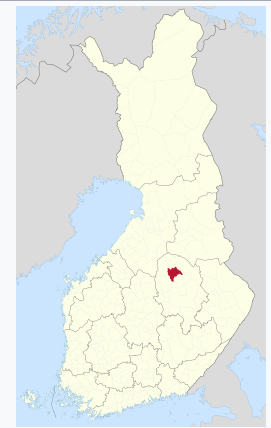
Victor Heino was born Wihtori Hujanen in the village of Nerkoo in Iisalmi country parish, in east-central Finland. The first known Hujanen in Iisalmi was Olof Hujanen, born about 1600. He lived near Lambaanjärvi, and several generations of the family lived in that area.
His great-grandson Olof Hujanen was born in the first decade of the 1700s, possibly as early as 1701 (but more likely a bit later). This Olof might have been born in Hatala. He moved to his wife’s family farm in Alapitkä by 1734, and then moved back to Hatala by 1740, where his son Gabriel and four other children were born. Olof would move again to Lappetelä 9 farm until his death in 1801, but his children remained in Hatala or moved to nearby villages after marrying.
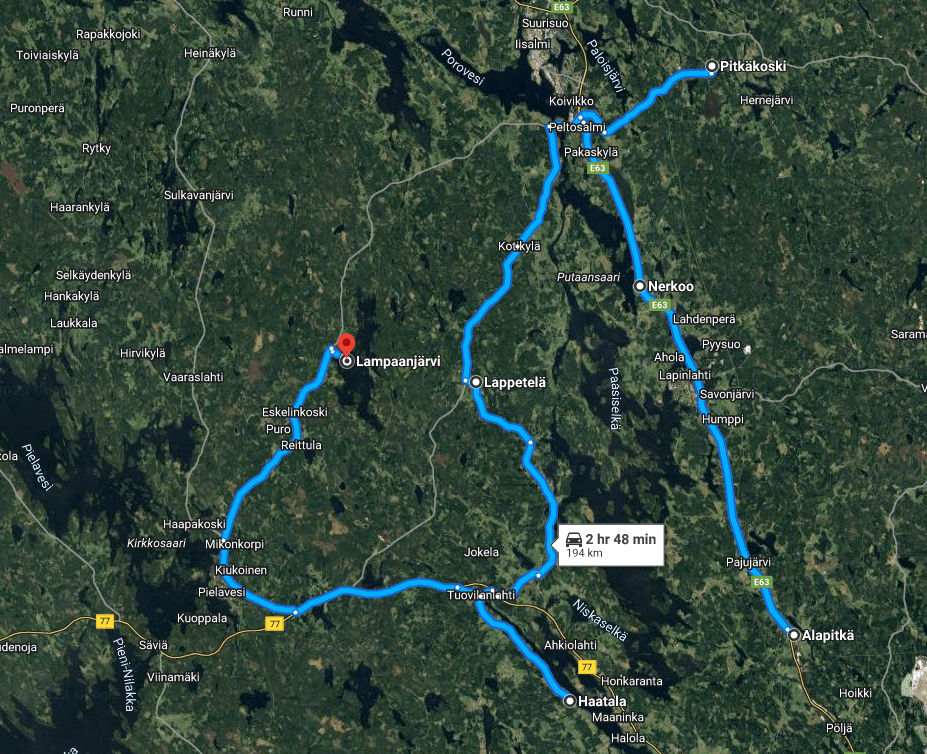
Gabriel Hujanen (1750-1831) married Anna Nilsdotter Huttuin (1758-1817) in 1780, and moved to her family farm in Wiita, Iisalmi, Finland. This would establish a long line of Hujanens in Wiita which continues to this day.
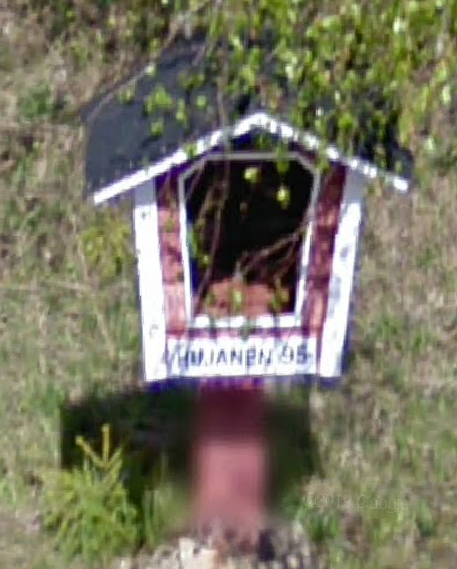
Gabriel’s farm was eventually called “Wiita 2” and then “Wiita 3.” It seems like the same farm continued under a different numbering. By 1827 the associated name “Pitkäkoski” was recorded for the first time. By 1839, Pitkäkoski was associated with Wiita farm 10. The name Pitkäkoski is still used today, associated in particular with a prime fishing spot frequented by tourists.
Gabriel’s descendant Jooseppi Hujanen (1856-1929), Victor Heino’s father, was born in Pitkäkoski and was the only surviving child of 5 in his family. He married Helena Ryhänen in 1879 and had two children in Pitkäkoski before moving around 1884 to Nerkoo, where their other 5 children including Victor were born. But they moved back to Pitkäkoski by 1900 and at least some of their descendants were there when my father and grandfather visited in 1973.
Victor Heino
Victor Heino left Finland for the United States in 1909. Family lore suggests he was leaving to avoid service in the Russian army, although Russia had granted Finland a degree of autonomy and it’s unclear how real that threat really was. It’s also possible that there were better opportunities in America for someone in his position than if he had stayed. His brother Wille (William) joined him in America by the next year.
Victor arrived in Boston on the Saxonia on 18 March 1909, after departing from Liverpool, England. How he got to England is a mystery. He listed Hancock, Michigan as his destination and his cousin Aker Hujanen in Hancock as his supposed sponsor. He was traveling with Erik Ryhänen, who was a cousin on his mother’s side of the family. He had $25. The ship carrying him and his cousin seems to have gone up the St. Lawrence waterway toward Michigan, but the exact details are unclear.
By 1910, Victor and his cousin Erik were living together in a boarding house of miners in Adams, Houghton County, Michigan, not far from Hancock.
At some point he left Michigan for Butte, Montana. There’s a 1912 record of a miner named Victor Heino living in Butte, Montana that could be him (though there was at least one other Victor Heino in Butte).
In 1916, Victor married Lydia Nurro, who was also a recent Finnish immigrant who arrived in Michigan in 1912 and then made her way to Butte. It’s unclear if Victor and Lydia had met in Michigan or only after they lived in Butte. Their only son Ralph was born the next year.
They lived close to the Berkeley pit and in fact the address of their home was engulfed by later mining operations. Victor worked with demolitions in the mines. He was also active in the IWW union (Industrial Workers of the World, the “Wobblies”).
Amid labor unrest in the mines and growing health problems, Victor and his family moved after 1920 to Aberdeen, Washington. He opened a barbershop. The Great Depression made times tough, but his son Ralph was able to go to community college and then attend Cornish College of the Arts. With the outbreak of World War II, Ralph joined the Army Air Force as a musician and aircraft mechanic in San Antonio, Texas.
Victor’s health worsened, and he died before his son Ralph was home from the war, in 1943.
Descent
Olof (Olli) Hujanen (c. 1701-1801)
m. 1734 Walborg (Valpuri) Hilduin (Hiltunen) (c. 1701-1790)
|
Gabriel (Kaapo) Hujanen (1750-1831)
m. 1780 Anna Nilsdotter Huttuin (Huttunen) (1758-1817)
|
Nils (Niilo) Hujanen (1782-1824)
m. bef. 1806 Brigitta Johansdotter (Riitta) Korolainen (1784-1858)
|
Nils (Niilo) Hujanen (1814-1891)
m. 1851 Maria Rönkkö (1824-1862)
|
Jooseppi Hujanen (1856-1929)
m. 1879 Helena Katrina Ryhänen (1858-1836)
|
Victor Heino (Wihtori Hujanen) (1889-1943)
m. 1916 Lydia (Lyti) Nurro (c. 1893-1975)
|
Ralph Heino (1917-2008)
m. Eleanor Luetcke Heino (1909-1995)
|
8 more Heino descendants in the USA, all still living

 A Place to Call My Own